Change Text Size
Email Columns Print page
Columns: The Online newspaper for the University of Georgia community
Show Index
October 3, 2011   Columns Articles | Research News | Body of work: Prof consults as forensic anthropologist…
Magnify Tersigni-Tarrant, MariaTeresa-H.Env.Portrait
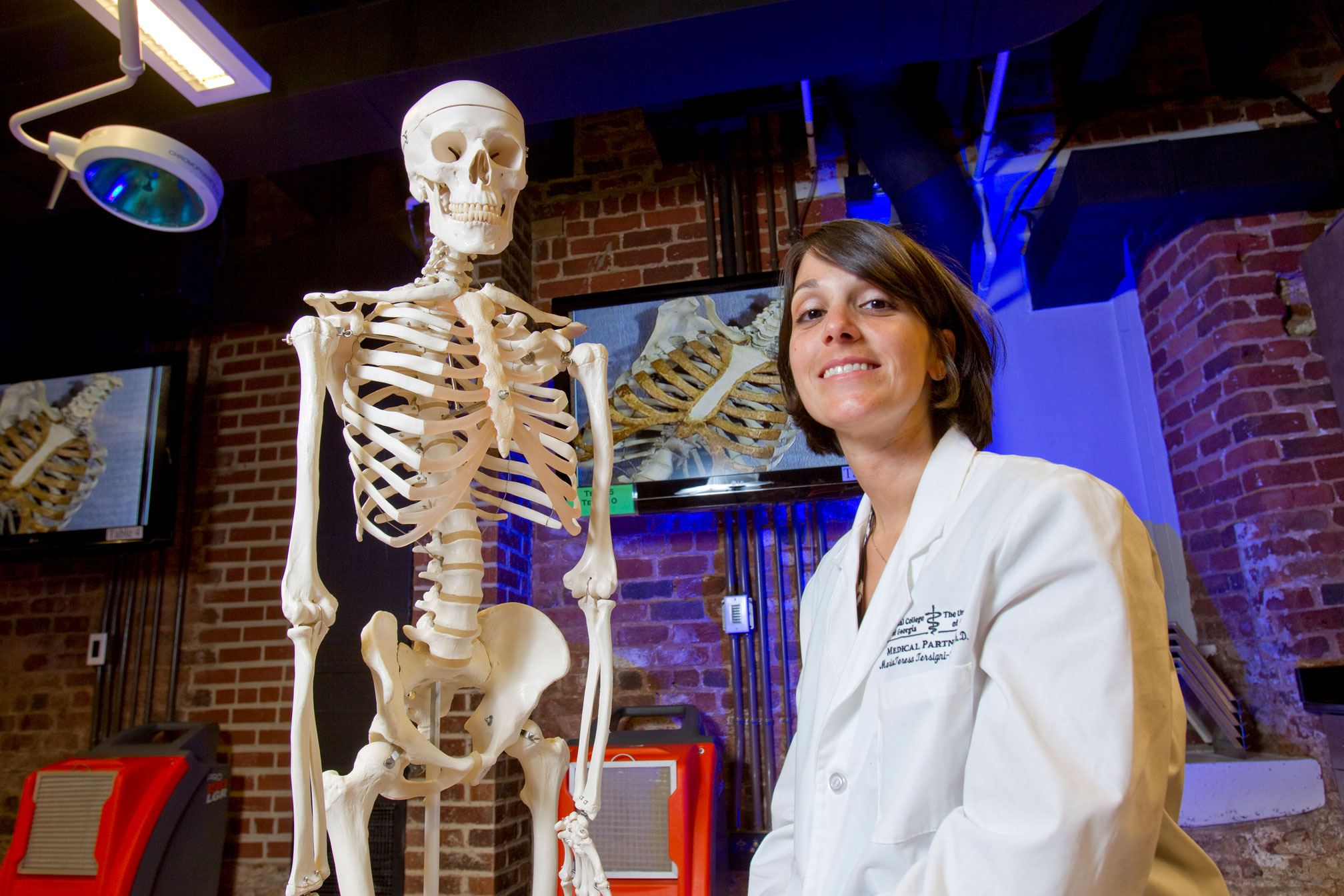
MariaTeresa Tersigni-Tarrant stays busy by working on cold cases at the GBI with help from one of her anthropology undergraduate students. The team builds biological profiles to upload to a nationwide database to help law enforcement identify victims. Photo by Paul Efland

Body of work: Prof consults as forensic anthropologist on cold cases with GBI

By Kathleen Raven | October 3, 2011
Share    

MariaTeresa Tersigni-Tarrant’s job  is not for the faint of heart.

As a forensic anthropologist, she helps solve cases with a decomposing body or skeletal remains and examines the manner—not the cause—of death.

And the Michigan native, who teaches gross anatomy and embryology at the Georgia Health Sciences University/University of Georgia Medical Partnership, can hardly imagine doing anything else. Tersigni-Tarrant approaches nonliving human bodies with serene respect and detective-like enthusiasm. Her attitude is probably quite comforting to first-year medical students tasked with logging 45 hours in her cadaver lab.

“I tell the students it’s very normal to feel really uncomfortable at first,” she said.

Forensic anthropology developed out of a need for science in legal situations involving death; it combines the sub-disciplines of physical anthropology and human osteology.

The popular television show Bones put the relatively obscure specialty on the map—and in the minds of undergraduate students who packed Tersigni-Tarrant’s fall 2010 “Introduction to Forensic Anthropology” course. She teaches the class every other year to fulfill her joint appointment as an  adjunct professor in the Franklin College of Arts and Sciences.

Her take-home message for aspiring forensic anthropologists: Be prepared to work in academia. Full-time forensic anthropologist jobs are rare, though television stars lead fans to think otherwise.

Tersigni-Tarrant herself practices her craft in brief intervals away from the university campus. Since 2009, she has consulted with the Georgia Bureau of Investigation on 41 cases. Only a handful of cases require Tersigni-Tarrant to go to the scene of a crime. More often, she drives to the GBI headquarters in Decatur to help with a decomposed or skeletonized body. A full examination can last between one and three days, depending on the body’s condition.

“If I have an entire skeleton, I can make a good estimation of age, sex, stature (height) and ancestry,” Tersigni-Tarrant said. “There is a lot of science involved.”

The information helps her create a biological profile used to understand who a person was. She also may perform a trauma analysis to shed light on the circumstances of the death. The medical professor laughed as she remembered devouring any Nancy Drew or Hardy Boys whodunit as a kid. Real life cases, by contrast, can be emotionally draining.

Tersigni-Tarrant approaches skeletonized remains as a scientist in any field might—by following a specific, tested process. Her ultimate goal is “to do everything I can to get a person identified and back with (his or her) family. I don’t like knowing that somebody’s still looking and I could do something about it.”

Soldiers’ families benefited from her skills during a post-doctorate fellowship she completed in 2005 at the Joint POW-MIA Accounting Command on Hickam Air Force Base in Hawaii. Tersigni-Tarrant created a new protocol there to help researchers differentiate animal and human bone fragments found in Southeast Asia on old aircraft crash sites. The new guidelines meant that the pieces were examined at the command center’s laboratory first before deciding whether to ship them to Washington, D.C., for DNA analysis. This procedure saved time and money for the researchers.  

After her post-doc, Tersigni-Tarrant settled back into her other passion: teaching. Before coming to the Medical Partnership, she taught anatomy at the Philadelphia College of Osteopathic Medicine in Suwanee. The faculty position at the Medical Partnership gave her an opportunity to teach anthropology courses again and to be part of a medical school curriculum that emphasizes small-group learning.

“I love teaching what I’m passionate about,” she said. “I love watching students come up with the ‘a-ha’ moment, and say ‘Man, I get it!’ ”

More from this issue

  • October 3, 2011

    Role models

    Four UGA faculty members—Steve Oliver, Jay Rojewski, Peter Smagorinsky and Sally Zepeda—have been named the College of Education’s inaugural Distinguished Research Mentors for the 2011-2012 academic year. Continue

  • October 3, 2011

    Search committee seeks dean for arts and sciences

    Provost Jere Morehead has appointed a committee to begin a national search to fill the position of dean of the Franklin College of Arts and Sciences. Continue

  • October 3, 2011

    Branching out

    Shelley Cannady wants help. For years now the assistant professor in College of Environment and Design has been growing grapes for the North Georgia wine market. Continue

  • October 3, 2011

    Obituary, Linda Brooks

    Linda Marie Brooks, an associate professor in the department of comparative literature, died June 7 at the Duke University Medical Center. Continue

  • October 3, 2011

    Online encyclopedia to celebrate first billion hits with symposium

    DiscoverLife.org, an online interactive encyclopedia created by John Pickering, an associate professor in the Odum School of Ecology, will reach its first billion hits this fall. Continue

  • October 3, 2011

    Alumna receives MacArthur Foundation’s ‘genius award’

    A.E. (Alicia) Stallings, who graduated from UGA in 1990, has been selected as a 2011 MacArthur Fellow by the John D. and Catherine T. MacArthur Foundation. Stallings is one of 22 receiving the fellowship this year. Continue

  • October 3, 2011

    Researchers will share $1.2 million in grants from NIH

    The National Institutes of Health has awarded UGA two grants totaling $1.2 million for instrumentation to advance chemical analytical capabilities of biomedical researchers across campus. Continue

  • October 3, 2011

    Research team receives grant to develop software

    A team of UGA researchers has been awarded a $500,000 small business grant from the National Institute of Mental Health to develop interactive educational software aimed at teaching high school students how the five senses work in the context of the brain and how neurons work. Continue

  • October 3, 2011

    Political columnist joins Grady faculty as visiting professor

    Cynthia Tucker, Pulitzer-Prize winning columnist for the Atlanta Journal-Constitution, has joined the Grady College of Journalism and  Mass Communication as a visiting professor as part of a multi-year partnership between UGA and the newspaper. Continue

  • October 3, 2011

    Stream lined

    A long-term study investigating how altering nutrient inputs to streams affects forest-dwelling organisms has yielded surprising results. Continue

  • October 3, 2011

    Georgia Fund 2012

    Continue

  • October 3, 2011

    Student interns exhibit designs they created for Archway communities

    On Aug. 25, UGA students, faculty members and administrators gathered in the Tanner Building to view an exhibit by student interns who spent the summer creating landscape designs for Archway Partnership communities. Continue

FOR MORE ONLINE
UGA Twitter Facebook RSS
Columns is produced by the University of Georgia Office of Public Affairs | Feedback