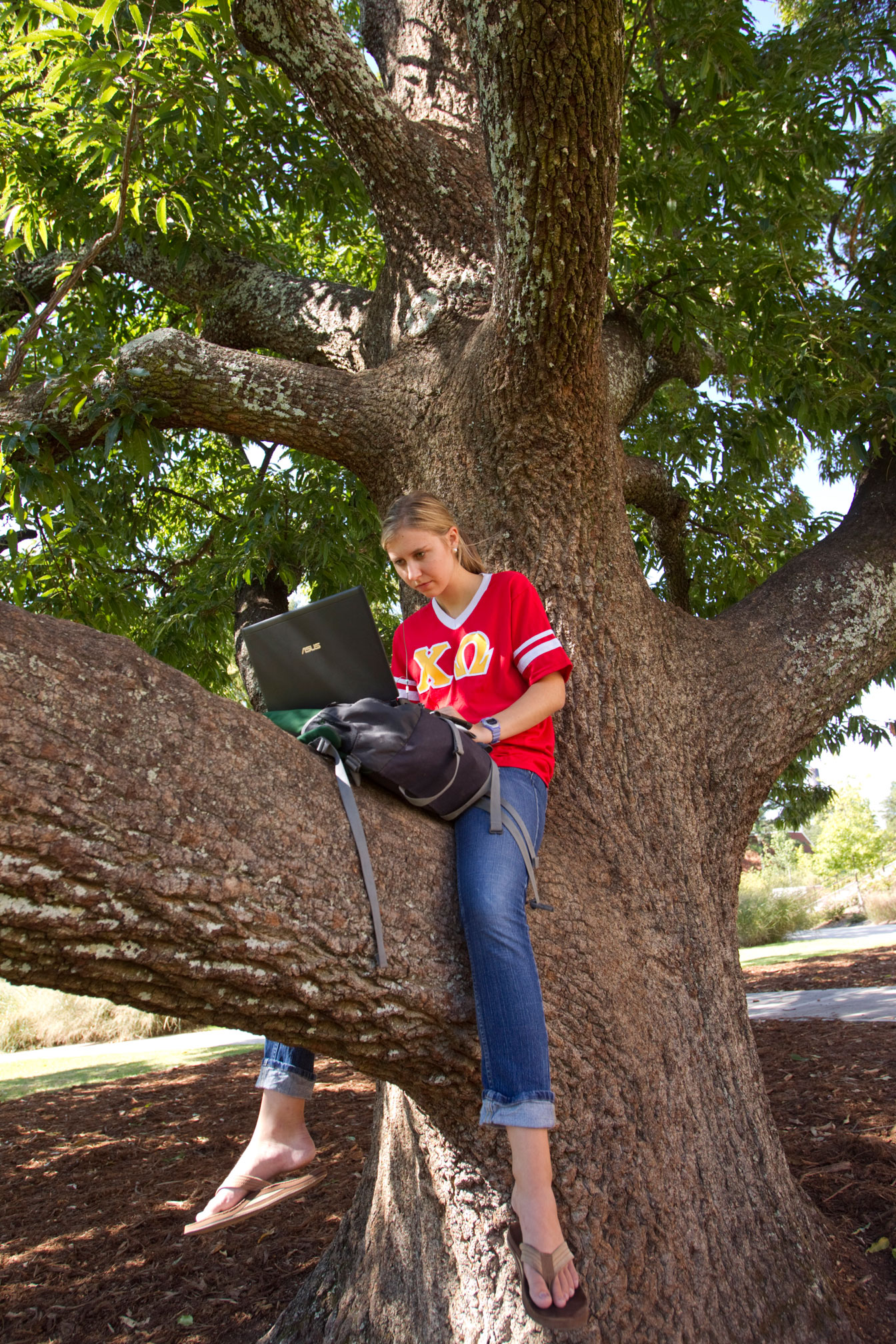
UGA named Tree Campus USA for third consecutive year
From the towering old oaks on North Campus to new maples gracing the landscape to the south, UGA's acreage is teeming with trees. Because of the university's continued commitment to maintaining and adding new foliage, the Arbor Day Foundation has named UGA a Tree Campus USA for the third year in a row.
The university has more than 9,000 trees on campus, according to an ongoing tree-mapping project being conducted by the grounds department. The number will continue to grow due to a partnership between Select Sustainable Tree Trust and UGA.
UGA named Tree Campus USA for third consecutive year
"I am very pleased to receive the Tree Campus recognition yet again and congratulate Dexter Adams and his staff for the very good work they do," said UGA President Michael F. Adams. "One of the things about which I am most proud is the greening of the UGA campus during the past 16 years, and the tree canopy here is an important part of that process. We are all privileged to spend time on one of America's most beautiful campuses."
Dexter Adams and his staff maintain the grounds on UGA's campus as a part of the facilities management division in the Office of the Senior Vice President for Finance and Administration.
Some UGA professors are incorporating campus tree toursinto their classes, and the trees are definitely more than a lecture slide for associate professor of horticulture Tim Smalley.
"Large trees set the stage for the important tenets of the university as a place of peace to settle the soul, a place of power to stir the soul and a soul-searching place to engender respect for the past and to promote caring for people and communities," said Smalley, a faculty member in the College of Agricultural and Environmental Sciences. "To paraphrase a common quote about the beauty of specific neighborhoods, I think it is appropriate to say that when people visit the university and say ‘Oh! What a beautiful campus,' they are really saying ‘Oh! What beautiful trees.' "
Tree Campus USA, a national program created in 2008, honors colleges and universities for effective campus forest management and for engaging staff and students in conservation goals. The Arbor Day Foundation and Toyota have helped campuses throughout the country plant hundreds of thousands of trees; in 2012, Tree Campus USA institutions invested $23 million in campus forest management.
UGA received the designation of 2012 Tree Campus USA by meeting five standards-maintaining a tree advisory committee, a campus tree-care plan, dedicated annual expenditures toward trees, student service-learning projects and an Arbor Day observance. The state of Georgia will observe Arbor Day on Feb. 15.
UGA named Tree Campus USA for third consecutive year
"Participating in Tree Campus USA sets a fine example for other colleges and universities while helping to create a healthier planet for all of us," said John Rosenow, founder and chief executive of the Arbor Day Foundation.
The main trees on UGA's campus are mapped for easy identification with the help of the UGA Campus Arboretum Walking Tour of Trees. The campus walking maps were designed by the horticulture department in the agricultural and environmental sciences college.

More from this issue
-
February 11, 2013
Committee appointed to find next dean for Terry College of Business
Provost Jere Morehead has appointed a committee to begin a national search to fill the position of dean of the Terry College of Business. Continue
-
February 11, 2013
Study offers new view of how bat disease spreads
The spread of white-nose syndrome, an emerging fungal disease in bats, may be determined by habitat and climate, scientists at UGA have found. Continue
-
February 11, 2013
Stegeman Coliseum marks 50th anniversary season
The 2012-13 academic year marks the 50th anniversary season for Stegeman Coliseum as a major venue for UGA athletics. Continue
-
February 11, 2013
COE faculty receive academic service-learning award
Corey W. Johnson, an associate professor in the College of Education, and Katherine F. Thompson, a clinical associate professor in the education college, received UGA's 2013 Service-Learning Teaching Excellence Award. Continue
-
February 11, 2013
‘The next chapter’
There's no shortage of change taking place in the publishing world as e-book sales continue to grow and the question of exactly how readers will buy books in the future remains uncertain. Continue
-
February 11, 2013
New top Dawg
With a unanimous vote on Feb. 4, the University System of Georgia Board of Regents approved Jere Morehead as the university's next president. Continue
-
February 11, 2013
Four Grady College deanship finalists to give presentations
Four finalists for the position of dean of the Grady College of Journalism and Mass Communication will visit campus in February to meet with members of the university community. Continue
-
February 11, 2013
Founders Day speaker analyzes humor in US Southern history
Little was left sacred at the Chapel on Jan. 30 as James C. Cobb, the B. Phinizy Spalding Distinguished Professor in the History of the American South, delivered the Founders Day Lecture, which examined Southern humor. Continue
-
February 11, 2013
New program to teach researchers how to share expertise with others
The vast repository of expertise within research institutions like UGA can provide answers to some of the world's most pressing problems. Continue
-
February 11, 2013
The bottom line: Assistant director helps manage university’s budget
As the workday winds down on Wednesday afternoons, others working in the University Budget Office know to stay out of the way of assistant director Vonnie Swain as she "runs out the door" to make it to a Zumba dance class on time. Continue
-
February 11, 2013
R.E.M. adviser to take part in talk at Chapel
Bertis Downs, an Athens entertainment lawyer and longtime adviser to the Athens band R.E.M., will take part in a talk on Feb. 18 at 4 p.m. in the Chapel. Continue
-
February 11, 2013
Out of the blue
Light emitting diodes, more commonly called LEDs, are known for their energy efficiency and durability, but the bluish, cold light of current white LEDs has precluded their widespread use for indoor lighting. Continue