Prof helps students explore early modern Spanish writing
We're all taught early in school some version of the story about Christopher Columbus stumbling onto the New World in 1492.
Beyond that, the average American's knowledge of Spain's imperial expansion probably ranges from a few names of conquistadors to practically nothing.
Prof helps students explore early modern Spanish writing
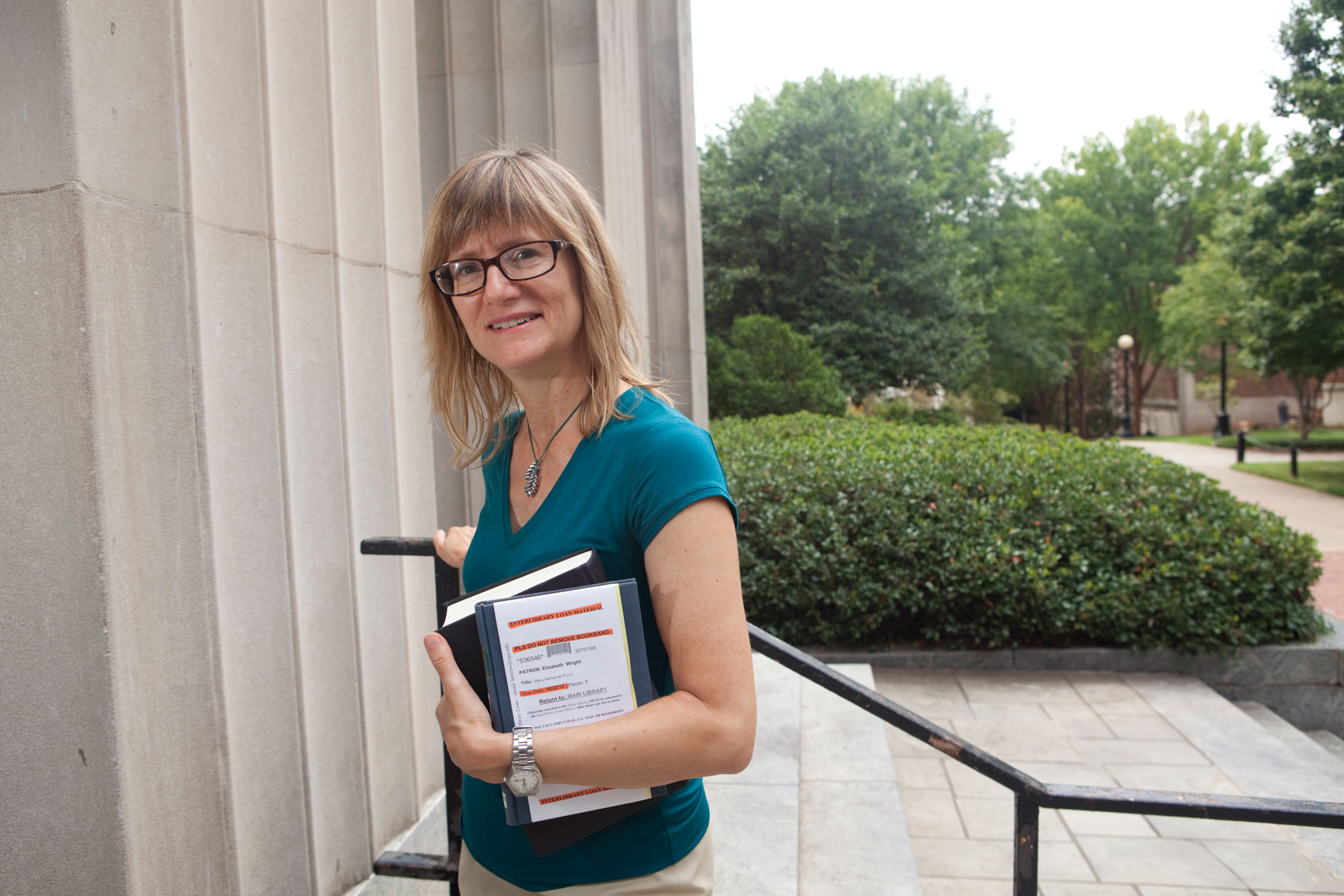
For Elizabeth Wright, an associate professor of Spanish in the Franklin College of Arts and Sciences, developing a broader understanding of Spanish imperialism as it played out both in Europe and the Americas through literature is a way to better understand America's rich history.
Wright's research and teaching focus on the writing of the early modern Spanish period (1492-1800).
"It's important that we not limit our perspective to (Hernán) Cortés, Columbus, Ferdinand and Isabella-though they are fascinating and important-but also consider others," said Wright, an Illinois native whose mother was born in Mexico.
As a Spanish literature professor, Wright teaches students to read, speak and think in the Spanish language at a deeper level, in part through their own research projects, or as she puts it, "to get them to think about how different people lived in earlier periods, to bring together voices that might not be talked about in the more famous literary texts you would study."
One little known but compelling historical figure that Wright has focused on in her research is Juan Latino, a 16th-century former African slave who became a Latin professor and poet in Granada, Spain.
Wright researched Latino's story extensively while working on a translation project funded by an Endowment for the Humanities grant.
Prof helps students explore early modern Spanish writing
The project, a collaboration between Wright, Sarah Spence, a Distinguished Research Professor of Classics in Franklin College, and former UGA student Andrew Lemon, resulted in a compilation and translation of poems inspired by the 1571 Battle of Lepanto, a monumental naval battle between a coalition of southern European Catholic states (Spain, Venice and Rome) and the Ottoman Empire.
Latino penned an epic poem inspired by the battle.
Wright said the battle, with a death toll of approximately 40,000, is considered by some to be a turning point in modern history and spawned countless commemorative poems.
The translation of these poems is now in the editing stages with the Harvard University Press.
With almost six years of working together, Spence praises Wright's contributions to the project and describes the work with Lemon and Wright as "a happy collaboration."
"She has this very detailed sense of what was going on at that point in history and this amazing skill with languages," said Spence, who describes how the Spanish professor mastered Latin to the level of expertly translating the poems for the project.
Prof helps students explore early modern Spanish writing
Interest in the subjects that Wright researches and teaches seems particularly important as Hispanic tradition is playing a more prominent role in the U.S.
"The Hispanic heritage is our heritage as citizens of the U.S.," Wright said.
More from this issue
-
January 7, 2013
Commencement speakers urge graduates to ‘attack life’, keep learning
Countless hours of reading, writing and even some complex arithmetic paid off for scores of UGA students on Dec. 14 as they attended Commencement ceremonies at Stegeman Coliseum for the conferring of their degrees. Continue
-
January 7, 2013
Five faculty members named inaugural AMS Fellows
Five UGA faculty members are among mathematical scientists from around the world named Fellows of the American Mathematical Society for 2013, the program's initial year. Continue
-
January 7, 2013
Lawmakers explore legislative agenda during Biennial Institute
Members of Georgia's General Assembly convened on campus last month for the 28th Biennial Institute for Georgia Legislators. Continue
-
January 7, 2013
Economic forecast: Georgia’s 2013 growth to outpace nation’s
Georgia's economic growth is on track to outpace the national average in 2013. Continue
-
January 7, 2013
New scholarship program will help recruit, retain qualified students
UGA has launched the Gateway to Georgia Scholarship Program. Continue
-
January 7, 2013
NSF renews $5.8 million grant for coastal research
A consortium of universities headed by UGA will continue ecological field research on the marshes and estuaries of the Georgia coast following the renewal of a six-year, $5.8 million grant from the National Science Foundation. Continue
-
January 7, 2013
Center for Food Safety study finds essential-oil blend reduces salmonella contamination
Oil and water may not mix, but a UGA study found feeding chickens a blend of plant-based oils in their drinking water can help prevent salmonella contamination before the meat reaches the dinner table -- or even the grocery store. Continue
-
January 7, 2013
Ecologists examine role of host shifts in disease emergence
The number of genetic mutations that follow host shifts in rabies virus impacts the speed of disease emergence in new host species, according to new research by ecologists at UGA and the Centers for Disease Control and Prevention. Continue
-
January 7, 2013
UGA’s top legislative priority: Maintain full-formula funding
After a return to full-formula funding for the University System of Georgia by last year's session of the Georgia General Assembly, a top priority for the university in the 2013 session opening this week will be maintaining that funding. Continue
-
January 7, 2013
Two seniors named ambassadors to energy conference
UGA's Bioenergy Systems Research Institute and the Office of Sustainability have selected two undergraduate students to serve as ambassadors to the inaugural Southeastern Conference Symposium. Continue
-
January 7, 2013
OID shepherds campus diversity efforts
Michelle Garfield Cook has been associate provost for institutional diversity for almost one year. Columns talked with her about the status of the university's diversity plan, projects her office is working on and what's next for diversity at UGA. Continue
-
January 7, 2013
UGA remembers Connecticut school shooting victims
In a simple and somber ceremony, members of the UGA and Athens-area communities honored the victims of the Dec. 14 shooting at Sandy Hook Elementary School in Newtown, Conn., by ringing the university's Chapel bell 26 times, joining others in similar ceremonies observed across the nation. Continue