Change Text Size
Email Columns Print page
Columns: The Online newspaper for the University of Georgia community
Magnify Huang, Jack PFC cleanup-h.env
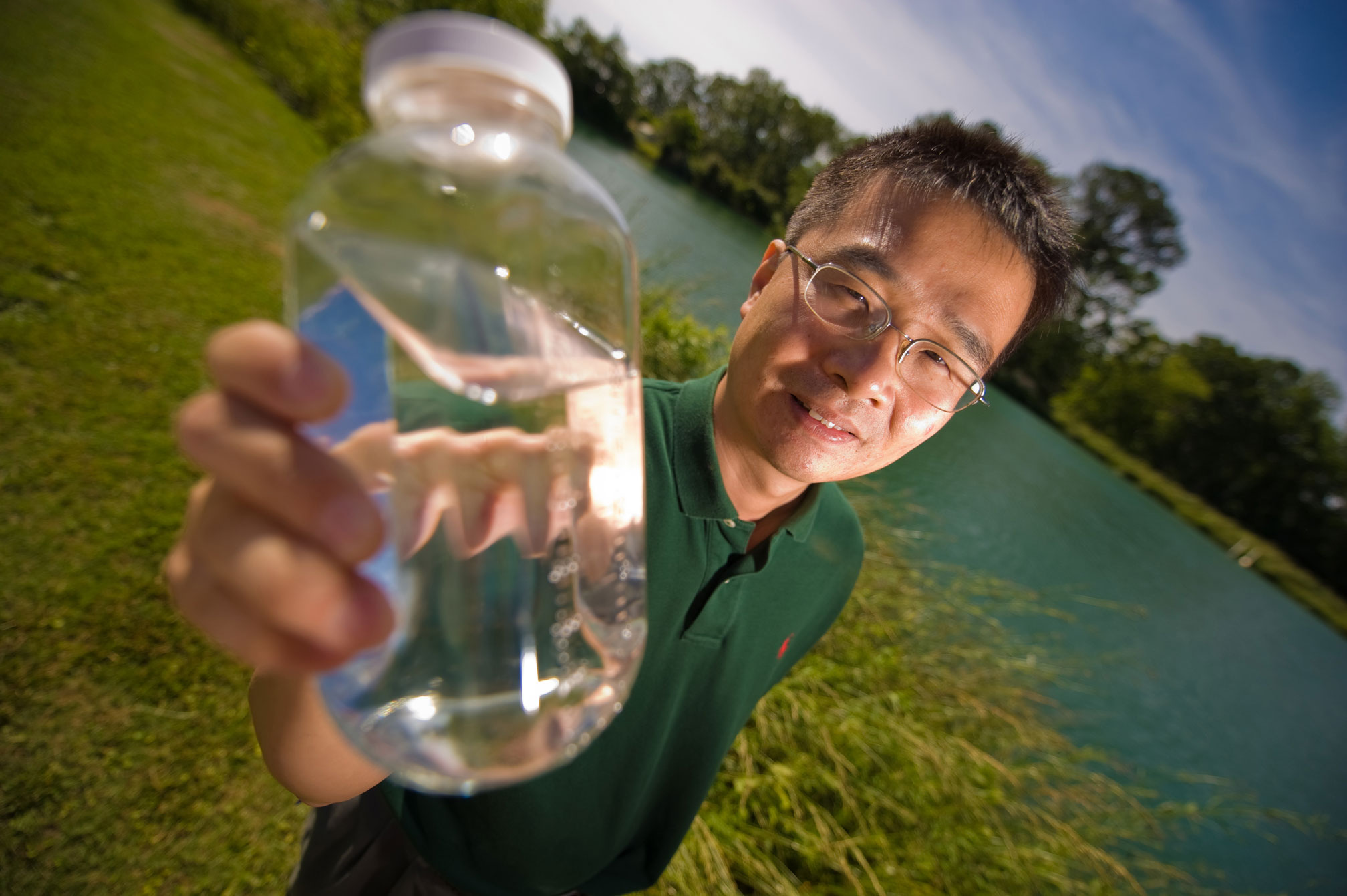
UGA environmental chemist and associate professor Jack Huang holds a jar of water for a research project on the UGA campus in Griffin. Photo by Stanley Leary/UGA

DOD grant funds research into cleanup of contaminated soil

Sharon Dowdy

Public Relations Coordinator

Recent and archived articles by Sharon Dowdy

Office of Communications and Technology Services
College of Agricultural and Environmental Sciences
Work: 770/229-3219
Email:
By Sharon Dowdy | October 1, 2012
Share    

Perfluorinated chemicals, commonly known as PFCs, keep eggs from sticking to frying pans, protect furniture from spills and help firefighters fight blazes, but studies now show that some of these chemicals—particularly the ones used to fight fires—also are toxic to laboratory animals in varying amounts.

To help clean up these chemicals, the Department of Defense’s U.S. Air Force Center for Engineering and the Environment awarded UGA associate professor Qingguo “Jack” Huang a $689,431 grant to test the effectiveness of an enzyme-based approach for removing perfluorinated chemicals from contaminated soil.

“PFCs are emerging as -contaminates, and big users of these chemicals are concerned about cleaning them up,” said Huang, an environmental chemist with the College of Agricultural and Environmental Sciences. “These chemicals are robust and hard to degrade, and none of the current technologies are practical for remediation.”

The defense department and the U.S. Air Force are searching for a way to remove the chemicals and have recognized that Huang’s work on the UGA campus in Griffin could be the answer.

The U.S. is one of  several countries looking for a way to clean up these chemicals “that chemists designed a long time ago,” Huang said. Governments in Australia, Canada and the European Union have placed restrictions on how these chemicals are used. California, Minnesota and New Jersey already have regulations in place, and efforts are being made to clean up areas—mostly firefighting training centers and industrial sites—where the chemicals have soaked into the ground.

“These products are used at military bases, airports and oil-drilling facilities, where fire-fighting practices are routinely performed,” Huang said. “These are big-scale uses that release the chemicals into the soil where they go into the ground water.”

Companies already are phasing out the manufacturing of some PFCs, and the U.S. Environmental Protection Agency plans to regulate certain types of PFCs soon, he said. Owners of locations where the PFCs have been regularly released likely will be responsible for removing the chemical’s residues from their land.

Huang’s goal is to take the concepts he has proven in the laboratory and test them in the field. He will first design and find the optimal formula of the enzyme, and then he will conduct tests at actual cleanup sites. AECOM, the largest engineering consulting company in the world, will serve as a subcontracting partner on the project and will handle the field aspect of the project.

“Basically, our project is a start,” Huang said. “These chemicals have made a significant profit in the past. Now, reports show they are harmful. The DOD is quite serious about this. Once these chemicals are regulated, PFCs will be a big responsibility because the contaminated sites will have to be maintained and cleaned up.”


View as single page

More from this issue

  • October 1, 2012

    Whitley joins UGA as new internal auditing director

    Matthew Whitley, who most recently was director of performance management and auditing for the Gwinnett County Board of Commissioners, is the university’s new director of internal auditing. Continue

  • October 1, 2012

    Study: Facebook a good place to teach food safety

    New UGA research published in the August issue of the Journal of Food Protection found that the social networking platform Facebook is good for more than keeping up with friends—targeted content can be used to teach college students how to safely prepare their own food. Continue

  • October 1, 2012

    ‘Alive again’

    Some are calling it a perfect match.    Continue

  • October 1, 2012

    Age-old questions

    The study of an oxygen-sensing bacterial regulatory protein by chemistry researchers at UGA has provided molecular insight into the oxygen sensing mechanism, which could ultimately lead to a better understanding of the aging process and new treatments for human diseases such as cancer, Parkinson’s and Alzheimer’s. Continue

  • October 1, 2012

    First inclusion certificate graduates honored at Embracing Diversity event

    Eighteen faculty and staff members were recognized at the Office of Institutional Diversity’s Embracing Diversity program on Sept. 17. They are the first recipients of the university’s certificate aimed at encouraging employees to explore areas of diversity and learn how to keep UGA an inclusive community. Continue

  • October 1, 2012

    Channeling history

    What was South Georgia like at the end of the 19th century? Tobacco and cotton fields as far as the eye could see? Yes, but also vast hunting plantations for the wealthy to indulge in genteel past times surrounded by natural beauty. Continue

  • October 1, 2012

    Board of regents will hold its monthly meeting at UGA

    For the first time in nearly 10 years, UGA will host the University System of Georgia Board of Regents’ monthly meeting Oct. 9 and 10.  Continue

  • October 1, 2012

    Researcher receives NIH grant to identify unknown anemias

    Microbiologist Harry Dailey has received a $1.5 million grant from the National Institutes of Health to study the molecular mechanisms behind a class of previously unidentified anemias that result from disordered processes in red blood cell formation. Continue

  • October 1, 2012

    Naturalist at home among dolphins, turtles, manatees on Skidaway Island

    John “Crawfish” Crawford often skips morning traffic on the long stretch of road connecting Skidaway Island to the state of Georgia by jumping into his motor boat and skimming over the waters separating his home on the Isle of Hope from his job—as a naturalist and captain of the Sea Dawg or, more formally, a public service assistant—at UGA’s Marine Education Center and Aquarium. Continue

  • October 1, 2012

    Workshop will examine food production, policy, sustainability

    UGA’s Center for Integrative Conservation Research is hosting a free workshop that will explore the links between food production, policy and sustainability on Oct. 1 in the Richard B. Russell Building Special Collections Libraries. Continue

FOR MORE ONLINE
UGA Twitter Facebook RSS
Columns is produced by the University of Georgia Office of Public Affairs | Feedback